№ 102026.07.19Essay6 minAlso in Portuguese
The Collective Mind: Why Your Team's AI Should Share a Brain
AI adoption in engineering teams is usually measured the wrong way. We count how many people use an assistant, how many prompts per day, how much code gets generated. But there's a silent cost these metrics miss: every engineer is building, in isolation, a context that dies with them.
The Problem Nobody Was Seeing
AI adoption in engineering teams is usually measured the wrong way. We count how many people use an assistant, how many prompts they send per day, how much code gets generated. But there's a hidden cost these metrics completely miss:
every engineer is building a private body of context that dies with them.
On my DevOps team, each engineer had their own AI assistant accumulating months of operational knowledge—rules like "never run this in a third-party production environment without a change request," architectural decisions behind each project, incident runbooks we'd already refined over time. Real knowledge. Expensive knowledge. Knowledge unique to how we operate.
And all of it remained trapped inside one person's conversations.
Two engineers would solve the same problem in the same week without realizing it. Every new session forced the AI to start from scratch.
Multiply that across a team over the course of a year, and the waste becomes enormous—almost invisible, but enormous.
The Solution: A Shared External Memory
I built what I call a collective mind: a single knowledge base, versioned in Git, that every AI assistant on the team can consult—Claude, Kiro, and whatever comes next.
Today it contains 225 operational knowledge notes, distilled from 34 projects, organized into 10 technical domains (Kubernetes, Infrastructure as Code, AWS, Incident Response, CI/CD, and more), heavily cross-linked, plus 16 specialized AI agents.
Everything is sanitized—no sensitive information—making it safe to share across the team.
Any engineer can connect their AI assistant to the knowledge base with just a few lines of configuration. From that point on, whenever the assistant lacks DevOps context that isn't available in the current repository, it consults the collective mind before answering.
The Network From the Inside: Markdown + Obsidian
The collective mind isn't a platform—it's a folder of markdown files versioned in Git. Each note is small and atomic: a runbook, a decision, an operational rule. What turns that folder into a network is one simple convention: every note points to other notes using [[wikilinks]].
Open the vault in Obsidian and every wikilink becomes an edge—the graph view reveals the team's "brain":
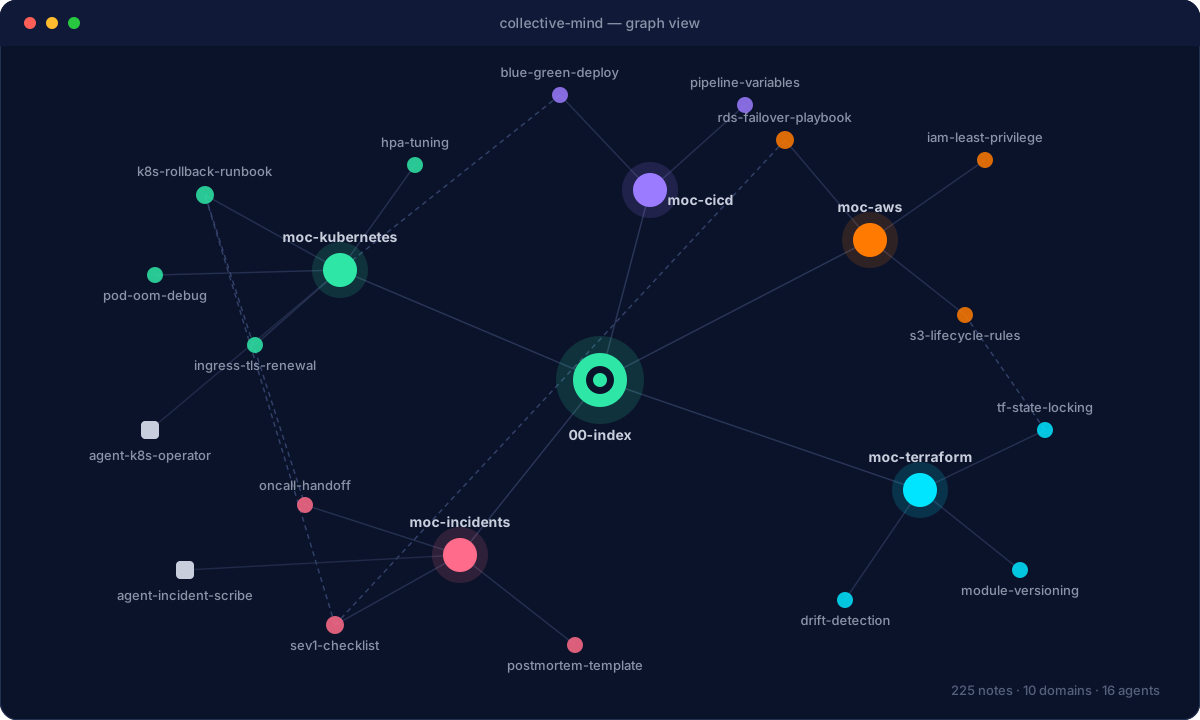
The structure you see there was never designed—it emerged on its own:
- Clusters are domains. Kubernetes, AWS, Terraform, incidents, CI/CD—each color is a group of notes that reference each other.
- The big nodes are MOCs (Maps of Content): index notes that list and connect everything in a domain. They're the entry point—for humans and AI alike.
- The dashed lines crossing domains are where the value lives. A Kubernetes rollback runbook pointing to the SEV1 incident checklist—that's the kind of connection no folder-based wiki captures.
In practice, a note looks like this:
# k8s-rollback-runbook
tags: #kubernetes #runbook

Before any production rollback:
- check the deploy window in [[deploy-freeze-policy]]
- if it is an incident, follow the [[sev1-checklist]]
- ready-to-run commands in [[helm-rollback-cmds]]

Never roll back a database migration without checking [[db-migration-rules]].

Related: [[moc-kubernetes]]
And here's how Obsidian displays it, with the local graph showing the note's immediate neighborhood:
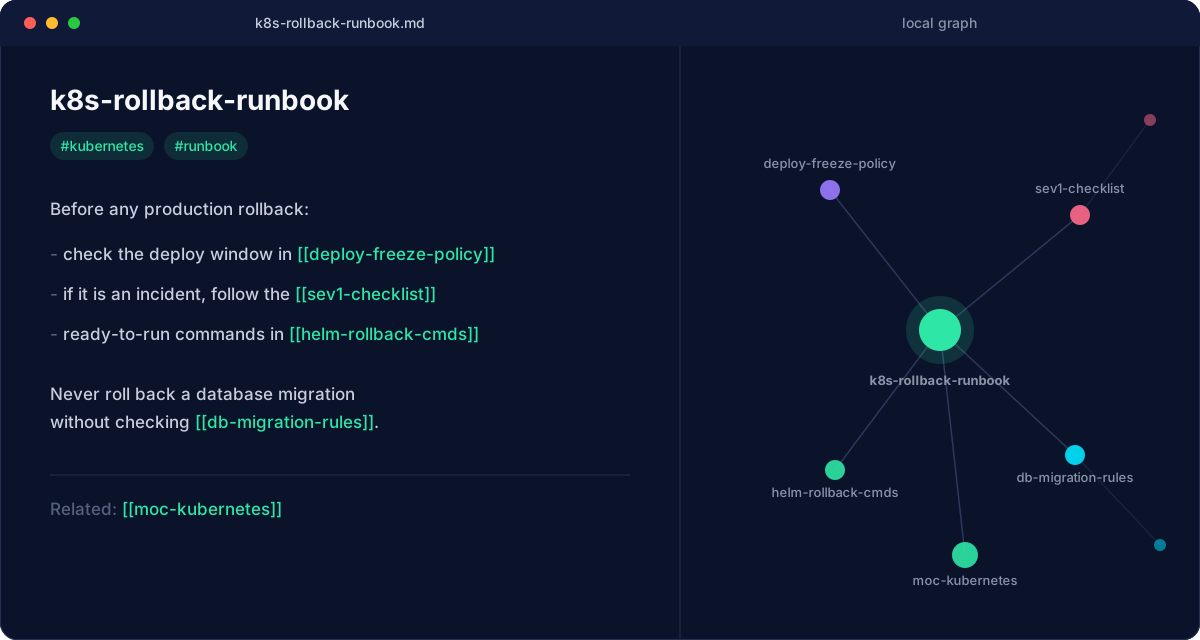
This graph is exactly what the AI traverses: it enters through a MOC and follows wikilinks the way an engineer would, reaching the right context within two or three hops. An orphan note—one with no links—is a warning sign: knowledge that exists, but that nobody, human or AI, will ever find.
It sounds simple.
But underneath it lies a technical—and scientific—reason why it works so well, and why it feels like the missing piece.
Why It Works: How LLMs Actually "Think"
One of the biggest misconceptions about large language models is that they learn and remember your conversations.
In most practical scenarios, they do neither.
1. LLMs Don't Have Long-Term Memory—They Reason Over Context
A language model generates responses based on what's inside its context window at that moment.
Outside of that window, it knows nothing about your previous interactions.
The mechanism that allows it to make use of new information without retraining is in-context learning: the model conditions its reasoning on whatever information is present in the prompt.
The implication is straightforward:
If your team's knowledge isn't available when the model needs it, it will either reinvent it—or worse, hallucinate a plausible but incorrect answer.
The collective mind serves as the external memory the model architecture doesn't possess.
This follows the same principle behind Retrieval-Augmented Generation (RAG), where a model retrieves relevant external knowledge before generating its response.
2. Better Context Means Fewer Hallucinations
Language models hallucinate more frequently when operating outside their knowledge boundaries and without supporting material.
Providing factual, domain-specific context anchors the model's reasoning and significantly reduces this behavior.
For an engineering team, this means every assistant starts producing answers grounded in the team's actual decisions, rather than generic assumptions learned from the public internet.
Why This Was Missing: The Problem Is Knowledge Management, Not AI
Ironically, the most interesting theory behind this idea doesn't come from AI research.
It comes from knowledge management.
3. A Team's Most Valuable Asset Is Tacit Knowledge
Knowledge exists in two forms:
- Explicit knowledge—what is documented.
- Tacit knowledge—the practical know-how living inside people's heads.
Classical knowledge management argues that organizations create value by transforming tacit knowledge into explicit knowledge that everyone can reuse.
The collective mind is, in practice, an externalization mechanism.
It captures the operational knowledge that naturally emerges during interactions with AI and turns it into a durable, shared artifact.
4. Group Memory Is Real—and Distributed Memory Is Fragile
Teams naturally develop what's known as a transactive memory system: a shared understanding of who knows what.
This works well while everyone is around.
It breaks the moment someone leaves—or simply goes on vacation.
A shared knowledge base externalizes that memory into something independent of any individual.
5. Knowledge Silos Create Measurable Coordination Costs
Every problem solved in isolation creates an invisible tax.
The next engineer has to pay again to rediscover the exact same solution.
Organizational theory describes this as a coordination or transaction cost.
Reducing duplicated discovery directly reduces those costs.
Three Tangible Benefits
When theory meets day-to-day engineering, the benefits become surprisingly concrete.
⏱️ Time
The effort of providing context to AI happens once for the team—not separately for every engineer.
Problems that have already been solved stay solved.
Knowledge compounds over time, making every future interaction faster.
💰 Resources
Fewer engineering hours are wasted rediscovering existing solutions.
Less rework caused by forgotten architectural decisions.
Fewer tokens spent rebuilding context the organization already possesses.
🎯 Consistency
When every AI assistant starts from the same source of truth, answers naturally converge.
Less variability between engineers.
Fewer mistakes caused by missing context.
Decisions remain aligned with the team's historical practices.
In operations—where a single incorrect command can impact production—consistency isn't a luxury.
It's a safety mechanism.
The Insight: Treat AI as a Network, Not as Individual Tools
The breakthrough wasn't a more capable AI model.
It was a change in perspective.
Stop treating AI as a personal productivity tool, and start treating it as a network of assistants sharing a common brain.
Individually, every AI assistant is a brilliant worker with amnesia.
Connected to a shared memory, they become a team that learns.
Intelligence stops being a property of isolated conversations and becomes a property of the system itself—the kind of capability that only emerges when independent parts become connected.
I didn't build a better AI.
I built the collective memory our team always had—but could never truly share—and gave it an address that any AI can read.
If you're building shared knowledge systems for AI-enabled engineering teams, I'd love to exchange ideas. We're still collectively inventing this space.